What your AI visibility score can't tell you
Let's do an AI visibility audit together. To do this, I'm going to use a brand I used to work for, Libbey Glass in Toledo, Ohio. I spent four years in digital marketing there and left more because of Covid's impact and uncertainty than any feeling of "Ugh, I need a new job." I loved the products and my coworkers, the history is endearing, and we had just completed a successful direct-to-consumer transformation.
But let's act like I never left for a second. So now it's 2026 and my boss asks me to run a report for them.
TLDR: A SEMrush AI visibility score within the range of competitors looks acceptable until you check what's underneath it. Two years of community data, prompt testing and thousands of customer conversations later — Libbey has zero organic mentions in the categories AI says they win, AI is routing premium queries to competitors, and the luxury copy I wrote for them back in the day did nothing to change it. Here's what the score couldn't tell me and what to do about it.
What does an AI visibility score actually measure?
Okay, bossman asked me to run a competitive AI visibility check for our Signature line of premium products. What I would have done is Google, "how to do an AI visibility audit" and see a guide from SEMrush — perfect! I already have an account for keyword research, so now that they have the AI visibility scores, it's easy-peasy.
I capture the scores for Riedel, the German crystal brand that dominates premium stemware, and Spiegelau, a premium glassware brand competing directly in the same consumer tier as Signature.
SEMrush AI Visibility Scores:
Riedel: 55
Libbey: 41
Spiegelau: 39
As the marketing lead building a budget case, those numbers do exactly what they need to do. They tell two stories at once. Story one: we're ahead of Spiegelau by 3 points, proof the current strategy is working, protect the budget. Story two: we're 13 points behind Riedel, a German crystal brand with decades of sommelier positioning behind it, and we can close that gap with more investment. Screenshot the table, drop it in the deck, walk into the meeting feeling prepared.
WRONG.
Here's what I found when I went one layer deeper.
How I run an AI visibility audit that goes beyond the score
The first step is finding out what the target audience is actually saying in the communities where purchase decisions get made — in their own words, in the behind-closed-door kind of conversations they have with their friends. It's like being a fly on the wall for your entire target persona. Pretty helpful, wouldn't you say?!
What audience intelligence reveals that an AI visibility score misses
I pulled two years of community data across three areas where Libbey has made real investments: the tiki category, the Signature wine glass line and its registry positioning, and how AI describes the brand overall. Here's what I found in each one.
What does the tiki community actually talk about — and is your glassware brand part of that conversation?
Libbey made a real and visible commitment to the tiki category. The Kahiko collection was designed by Daniele Dalla Pola, a tiki bartender with serious credibility — the kind of name that means something to people who know what a proper Zombie glass setup looks like. This wasn't a product line slapped with a tiki label. It was a genuine category investment with a credentialed collaborator behind it, and the Kahiko Zombie Glass Set is still a featured collection on their Amazon storefront today.
Across two years of data from dedicated tiki communities, Libbey doesn't appear once. Not one organic mention.
So I ran the prompt a serious cocktail person would actually type: "What are the best tiki glasses for a home tiki bar from a serious cocktail perspective?" ChatGPT named the Libbey Tiki Kahiko Zombie Glass Set by name and filed it under functional utility — durable, stackable, consistent, listed alongside Anchor Hocking as a solid workhorse option. Daniele Dalla Pola wasn't mentioned. The collaboration wasn't mentioned. The cultural intent behind the collection wasn't mentioned. Oof.
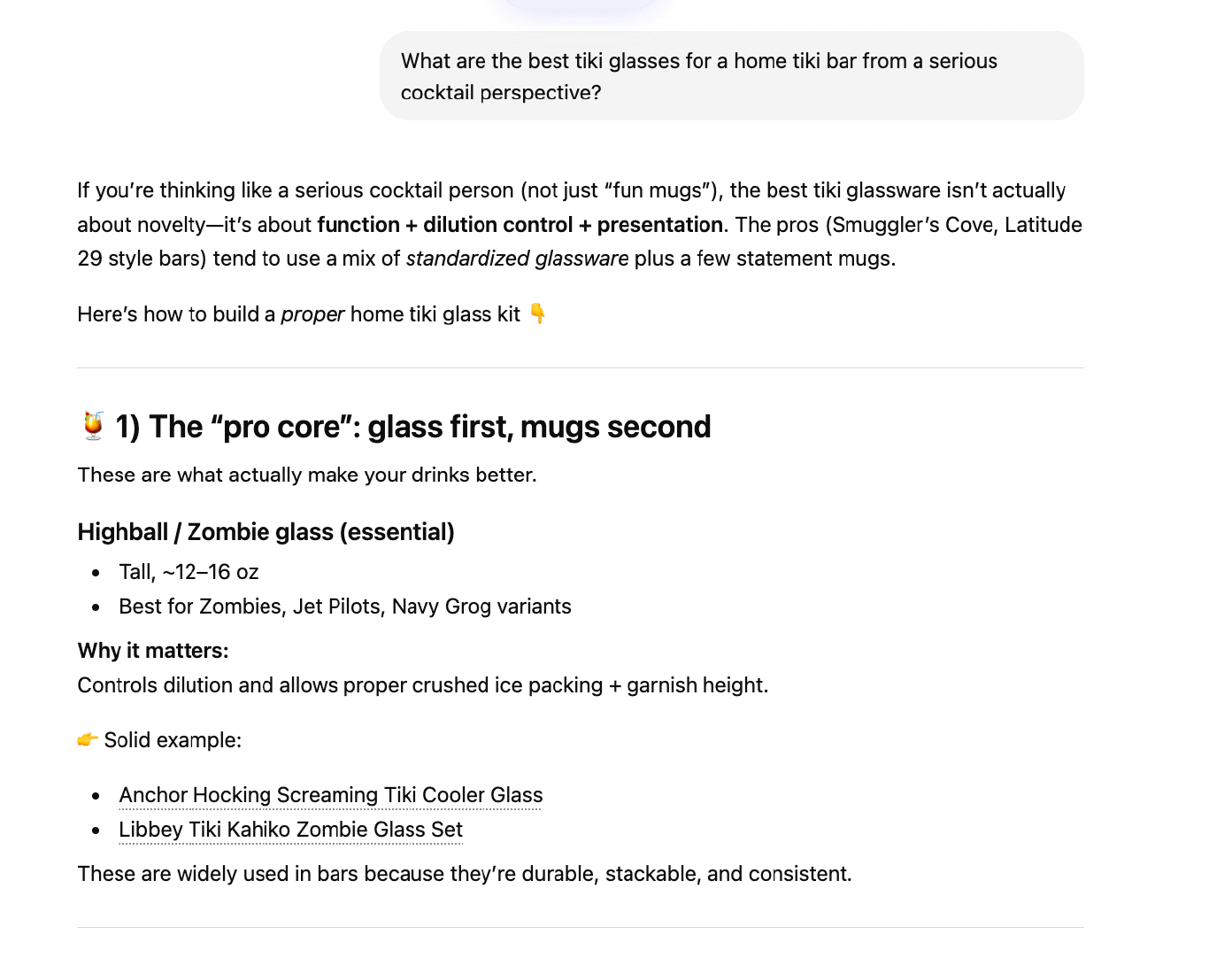
Here's what that result is actually telling you, and it's worth slowing down on.
The content describing the Kahiko collaboration exists somewhere in the digital ecosystem. The product surfaces by name. But AI stripped every layer of meaning that was supposed to make that collection different from any other glass manufacturer's tiki line, because AI doesn't build brand identity from what a brand writes about itself. It builds brand identity from what real people say about a brand in real conversations — and real people, consistently, across years of reviews and community mentions and purchase discussions, describe Libbey as the durable everyday glass. The budget-smart choice — the one that survives the dishwasher and the commercial kitchen.
That signal is so cemented that a designer collaboration can't break through it at the product description level. AI reads "Libbey Kahiko" and files it under functional because that's what the entire conversation layer says Libbey is. The brand identity overrides the product positioning every time.
This is why writing with marketing speak like "epitome of luxury American craftsmanship" into a listing doesn't move the needle. AI isn't reading your copy in isolation. It's reading your copy against everything the actual market has said about you, and the actual market has been consistent.
Which also means the fix isn't more premium language on the Kahiko listing, and it isn't more content explaining who Dalla Pola is. The fix is content that lives where real conversations happen — consistently connecting durability and craftsmanship as a single advantage that belongs to Libbey — so AI has a new signal set to pull from over time. Not a repositioning, but an honest claim on the position the data says Libbey is already winning, made loudly enough and consistently enough that AI starts routing the right queries there.
The Dalla Pola collaboration was the right instinct, it just needed the content ecosystem to match the investment.
What wine glasses should I register for? The $50-100 question no brand is answering
Libbey has an active Zola partnership. Couples building registries can find and add Libbey products, from wine glasses to bakeware. That's a real distribution investment in a high-intent channel — people building wedding registries have already decided to buy (or rather, their guests have decided to buy), they just haven't decided what.
So I ran three ChatGPT prompts to see what a bride actually gets when she asks AI for help:
Prompt one: "What are the best wine glasses to register for my wedding? I want something that looks fancy but is durable and dishwasher safe." Libbey: not mentioned once. Schott Zwiesel dominates every tier of the response — overall best, upgrade pick, honest recommendation. ChatGPT's own summary: "They basically dominate this exact niche."
Prompt two: "What are the best wine glasses under $60 for a set of four that are dishwasher safe and don't look cheap?" Libbey Signature Kentfield appears — priced at $52.64, more expensive than the Spiegelau at $36.99 shown in the same response — and still gets labeled "best value." 🤔 Spiegelau costs less and wins "best overall." ChatGPT's quick summary: best overall Spiegelau Style, best value Libbey Signature Kentfield.
Prompt three: "Compare Libbey Signature wine glasses to Riedel and Spiegelau for a wedding registry." This one is the most interesting. ChatGPT gave Libbey Signature a five-star registry practicality rating — highest of the three brands, with Riedel at three stars. The recommendation for a practical couple: Libbey Signature. But when it showed product images to illustrate the pick, it pulled the $24.99 Classic line from Walmart instead of the Signature Kentfield that earned the rating. The analysis was right. But the brand signal is so cemented as budget-conscious that it doesn't surface the premium product even to support its own conclusion.
That's not a problem — it’s an opening. Schott Zwiesel owns the aspirational registry query right now. Libbey has the stronger practical case — five stars for registry practicality, commercially proven durability, made in the USA, active Zola partnership — and zero content that makes AI connect those specs to the registry conversation. The brand that writes that content specifically and credibly enough for AI to cite owns that query. That content doesn't exist yet.
How does AI decide what your brand is known for — and can you change it?
The registry findings are a symptom. To understand the root cause, I ran one more prompt: "What style of wine glasses is Libbey known for?" The response came back organized and confident — classic all-purpose shapes, stemless and casual-friendly designs, durable restaurant-style construction. The bottom line: "Affordable, versatile styles rather than luxury specialization." And the closing offer: "If you want, I can compare Libbey to brands like Riedel or Zalto so you can see how their styles differ."
AI didn't get Libbey wrong. It synthesized the available signals accurately — the tiki-forward B2C site, the margarita glasses featured in the Zola partnership, the long-standing tagline about memories and gatherings, the Vina line appearing in restaurant supply queries. AI built a brand identity from what was loudest and most consistent, not from what the brand most wants to lead with. A score of 41 looks fine. The ACTUAL AI representation of the brand is built from signals that point consistently toward everyday and affordable.
This is the part that a score alone can't show you. You can have a perfectly acceptable AI visibility score while AI is actively routing premium purchase queries to your competitors, because the score measures discoverability and the representation is built from something else entirely.
Libbey is spending energy trying to position Signature as a Riedel alternative — a race they're not built to win — while the market they could actually own, the durable everyday glass that performs at the dinner party AND survives the dishwasher, sits wide open. And the content investments that would build that position? Being spent on tiki, a category whose community has no interest in mass-produced glass from a national manufacturer.
Why optimizing for luxury keywords doesn't make AI describe you as a luxury brand
Here's where it gets worth slowing down on. Because when you look at Libbey's actual Amazon listing copy and website product descriptions for the Signature Kentfield line, the keywords are unmistakably premium. Phrases like "unparalleled style and craftsmanship," "accessible luxury," "epitome of luxury American craftsmanship," "opulence and superior quality," "redefining luxury for your home" and my personal favorite — "touch your lips to the finely honed rim and complete your sensual journey."
Full disclosure: I wrote some of that copy. So this is not a critique of the team — it's a critique of a process I was part of, one that most marketing teams are still running today because historically it's been successful, but in reality, it's outdated. You identify the position you want to own, you write toward it, you optimize the keywords, and you assume the content layer will eventually shape how people perceive the brand.
Now go back to the Google AI Overview for "Spiegelau vs Libbey" — a query real buyers type when they're actively comparing options. The AI describes Libbey as: durable, budget-friendly, versatile, aimed at daily use and commercial foodservice, best for budget-conscious consumers, low-to-mid range price. Key takeaway: "Choose Libbey for everyday versatility, durability and better value for money."
AI read every word of the "sensual journey" copy and processed the "epitome of luxury" language…and it came back with budget-conscious. Because AI doesn't take its cues from what a brand writes about itself, it takes its cues from what real people say about the brand in real conversations — and real people, in the communities where purchase decisions actually get made, consistently describe Libbey as the durable everyday glass.
And that position — durable, commercial-grade, made in the USA, dishwasher safe, genuinely proven in high-volume settings — is not a consolation prize. It is a real and ownable competitive advantage that none of their premium competitors can match. Spiegelau's most viral community moment is someone breaking their glasses 18 seconds after unboxing them! Libbey's manufacturing credibility is the thing that wins the registry wine glass conversation if someone claims it.
The gap isn't between who Libbey is and who they want to be. The gap is between the position they're actually winning in the real audience conversation and the position they're trying to claim in the content layer. You can't write your way into a community perception that the audience data doesn't support. But you CAN build content that owns the position the data says you're already winning — and make AI recommend you for it every single time someone asks.
To confirm whether this signal came from community conversations or elsewhere, I ran an audit across nearly 1,000 conversations in the exact categories AI says Libbey wins: budget glassware conversations, durable everyday glass, first apartment setup and wedding registry. Libbey appears in three conversations and they’re strictly cocktail-related: Two are the same person trying to figure out if their glasses are actually Libbey and one is a thread with a passing mention.
Zero mentions in budget glassware discussions, durable everyday glass, first apartment setup and wedding registry — despite the active Zola partnership.
That absence tells you something important about where the AI signal actually came from. The "budget and durable" identity was built from commercial foodservice associations, product listings and review data — signals so dominant that “premium” lipstick copy can't override them. And because Libbey isn't present in the organic conversations where consumers actually talk, there's no counter-signal being built. The content layer is trying to reposition a brand whose community signal is essentially nonexistent in the categories that matter most.
What to do before your next category or channel investment
Libbey is the example here because I know their business well enough to make the analysis honest. But this pattern shows up in every brand I work with — channel investments where the distribution is working but the community presence that makes distribution convert isn't there, category conversations where nobody including competitors has claimed the AI answer, and a score that looks acceptable sitting on top of all of it.
I didn't have this methodology when I was at Libbey. The decisions that look different in hindsight were made without the full picture this process surfaces — and I want to be clear that I'm not saying they were wrong. Sales data and business context I don't have access to might make every one of them completely defensible. What I'm saying is the picture is now available, it's findable before the next investment cycle rather than after, and it changes what you build toward.
The SEMrush AI visibility audit is a real and useful starting point. Run it and track your score. Fix the technical foundation it helps identify, but then go one layer deeper — find out where the audience conversation is actually happening, what they're saying, and where the specific gap is that your brand and your content can fill before anyone else does.
In Libbey's case, the data points to five questions their content should be answering right now, and isn't:
What are the best wine glasses to register for that are actually durable and dishwasher safe?
What wine glasses do restaurants use and can I get them for my home?
What's the best wine glass set under $60 that doesn't look cheap on a dinner table?
How does Libbey Signature compare to Riedel and Spiegelau for everyday use?
What's the most practical wine glass for someone who entertains a lot and runs the dishwasher after every party?
This is what I do on a random Friday afternoon…
The process I outlined above isn’t even a full engagement — that's a Friday afternoon for me. Imagine what my full AI Intelligence Loop surfaces when it's a paying client with a real content strategy attached to it. If you're a brand or an agency working with brands, I'd want to talk to me yesterday. ;)
About the Author
Laura Seelinger is the founder of LSX Partners, a marketing strategy firm that helps agencies and businesses build strategy on real audience data and show up where buyers are actually searching, especially AI. She works with agencies as an embedded strategic partner and with businesses ready to stop guessing and start building on evidence. To implement this model into your marketing, let’s chat.