What I'd do if I was running marketing at American Greetings
I don't work with American Greetings and nobody asked for my opinion, but I loooove where we are right now with the pendulum swing of social content and analog connection (or what Gary Vaynerchuk calls the barbell effect), so this "marketing strategy disguised as a blog post" is literally what I like to do in my free time.
This is the first in a series. I decided to start with American Greetings because they're headquartered in my homestate of Ohio, they're a 100+ year old brand that is literally THE thing society is shifting toward (analog), and the data I compiled tells a story that most marketers would miss if they only looked at social, SEO or surface level AI scores. You have to zoom out in a way you haven't before to truly see what's happening and where the treasure trove of opportunity lies.
So let's go!
American Greetings is built for the subscription economy Gen Z just canceled
American Greetings is a 120-year-old brand. They've been pivoting the core business to a digital subscription platform (starting around $1.99-$7.99/month depending on plan, unlimited ecards, celebrity SmashUps, AI message writing, the whole techy thing). The problem is that their marketing 'says' they're a paper company (tangible, I can hold the product in my hands, display it on my mantel, etc.) but their visuals are all captured in a sterile photo studio or are digital renderings. And their AI brand identity reads like a company that hasn't decided which one it is yet.
The result is a brand that should be the definition of analog but showcases everything in digital format, and AI platforms are categorizing them as a greeting card company (accurate) but not aligning them with the moments they actually serve and support. Condolences when a pet crosses over the rainbow bridge. A birthday card you write an inside joke in that your friend displays on their desk. A wedding anniversary card your husband writes in about how much he loves you. When someone is asking ChatGPT for advice on how to support their loved one with whatever they're navigating, it's going to recommend Paperless Post, Thankbox, Postable or 1-800-Flowers, not American Greetings.
And that's just what's happening right now. Listen to Gary Vaynerchuk's prediction content and you'll hear that he thinks AI agents are going to start doing the shopping for us. So if AI isn't relating American Greetings with those life moments now, our future shopping agents won't in the future.
The data: 81% of Gen Z wants to disconnect and 86% need to feel the product
Let me explain why marketers need to respect and lean into Gen Z wanting to disconnect. You know how you sometimes wish you could go back to simpler times, like childhood or the 90s? Gen Z didn't get that piece of life the way Millennials did. Millennials were the bridge generation, the last one to grow up without the internet at first, then to evolve alongside it. We had "computer rooms" in our middle school, meanwhile Gen Z had their own Chromebook in elementary. We remember dial-up internet. We remember our first cell phone — with a plan that only had free texting after 9p (and T9 word). We remember having to share the family computer and put an away message up on AIM until it was our turn to use it. We remember a life BEFORE everything was always on.
Gen Z popped out and their tech-obsessed parents were already buying their kids' domain names as baby shower gifts (I legit remember this trend). They grew up native to screens, native to algorithms, native to social. They've never known a world without it.
And now they're 18-28 years old, and the Harris Poll's Return of Touch research found 81% of them wish they could disconnect from digital devices more easily, 86% say touching and feeling products is essential to their purchase decisions, and 87% have had it with the subscription economy that defined their entire digital lives. They're the generation that never got "simpler times" so now they're taking things into their own hands and building them.
It's not a trend, it's a generational trait. Gen Z is literally helping Fetty Wap trend again with songs from 2016. The old school rules, drool. This generation rewrites the script.
And it's the pivot American Greetings can literally own if they lean into it.
American Greetings AI visibility audit: what the data shows
I ran a full AI visibility audit on American Greetings using my AI visibility platform stack.
Overall brand consistency across the major AI tools is 65 out of 100 (ChatGPT 71, Gemini 70, Perplexity 55, Claude 67). Brand consistency measures how accurately each AI describes American Greetings compared to how the company describes itself. A score of 65 means every single platform is missing the same seven key features of AG's current business (more on that in a bit).
Then there's AI share of voice, which measures how often AG gets mentioned when someone asks AI a greeting-card-related question. And here's where the split between branded queries and use-case queries is important.
When the query is a branded category search ("what’s the best platform to send a digital greeting card because a real one won’t arrive on time”), American Greetings gets 80-100% share of voice. They show up because they're American Greetings — the brand recognition carries the citation or recommendation.
When the query is a use-case prompt ("what should I send my friend whose dog just died, something that feels personal," or "I want to send a congrats gift to my friend who just got a new job"), American Greetings' share of voice drops to 20%. And if you qualify those queries with "last minute" which a lot of card buying is (which many of our husbands probably would include in their prompt), ChatGPT and Gemini don't even mention American Greetings. Perplexity recommends Greetigram, Thankbox, Postable, Lovepop, Moonpig and Cardly. Every single one of those is a smaller company than AG, with a heck of a lot less history.
Quick aside on the above — someone could push back that "send my friend something" and "greeting card" aren't a perfect one-to-one, but this is exactly how AI works in real life (my bestie literally gave me this pushback after she read this article, so I added this paragraph). People don't search "best sympathy card brand." They describe the moment, and AI fills in the category. Right now AI is filling that category with flower delivery services and indie ecard platforms instead of the legacy brand that's been making greeting cards for 120 years. THAT is the definition of a visibility gap.
The same pattern shows up in the grounding search data, which are the searches AI systems run in the background to verify what they're about to tell you. AG only ranks in Google's top 30 for 19 out of 42 grounding searches the AI ran. Zero of those rankings are high-impact, meaning not even AG's competitors are ranking on these searches. Nobody in the greeting card category is winning them — probably because no one in the category understands AI visibility yet! The category is wide open, and the first brand to actually implement an AI optimized strategy will win the related searches. On the grounding search query "fastest physical greeting card delivery services USA holiday birthday," AG isn't in the top 30 while Hallmark is at number 6. On "retailers with same day greeting card pickup US," it's the same story. On "modern digital greeting card platforms 2026 reviews," AG doesn't rank. And if these searches seem odd and too long for a human to have typed, you're correct — these queries are what the AI uses to answer the questions us humans ask it.
The feature-level finding is the one that made me LOL. Across every single AI tool tested, American Greetings is missing the same seven key features in AI descriptions: Unlimited Sends, 7-day free trial, Celebrity SmashUps, AI Messaging, and three more. Quick aside on "Celebrity SmashUps" — this is AG's proprietary name for animated eCards where a celebrity appears to say the recipient's name (Rob Lowe, Ice T, Weird Al, Cookie Monster from Sesame Street). It's a real and differentiated product, but "SmashUps" doesn't tell you what it is. If YOU don't know what SmashUps are, AI doesn't either. Which is the whole problem with proprietary feature names — they only mean something to the people who already work there. I’ll have to do a deeper dive on my opinion of this in the future.
These are the actual differentiators of their CURRENT business — the ones that separate 2026 AG from 1950s AG, yet AI platforms do not know about them. They describe American Greetings as a "greeting card producer" or "manufacturer" in language that hasn't been comprehensively accurate for at least a decade.
And then there's Blue Mountain, which American Greetings owns. Every single AI platform (ChatGPT, Gemini, Perplexity and Claude) lists Blue Mountain as a COMPETITOR to American Greetings. The AI visibility problem is so deep that its own portfolio isn't clear.
The SEO picture: organic keywords down, paid keywords up 82%
Organic keywords are down 9.69% and paid keywords are up 82%. AG is spending its way through a declining organic position — which is the marketing equivalent of slapping ducktape on a leaking pipe.
Their top-ranking pages are "what to write in a card" inspiration guides (birthday wishes, congratulations messages, sympathy messages for pet loss) pulling 30K-35K monthly visits each — but I bet these visits will decrease when everyone just uses what ChatGPT gives them and they start handwriting the em dash. Those pages end with a button to join the subscription. It's top-of-funnel content with a conversion CTA slapped on, before the user is anywhere near warmed up enough to convert. It's like when you accept someone's invitation on LinkedIn and within 20 minutes they sent you a DM pitching their product. Bro, I was just being nice.
70.8% of their keyword portfolio is informational intent. It's a mountain of top-of-funnel content optimized for 2015 search. None of that is connecting with customers the right way in 2026.
The greeting card category and the analog resurgence
The greeting card category is the opposite of dying right now. Nine out of 10 U.S. households still buy them, Millennials are now the largest dollar-spend buyers in the category, and they're buying FEWER cards but MORE expensive ones. The Greeting Card Association calls this a "rebellious resistance to digital culture" (vinyl records, polaroids, handwritten cards — all of it is part of the same cultural movement).
I’m going to stan on Gary Vee again. The idea of his barbell effect is extreme technology on one side (AI, interest media, live shopping) and extreme analog on the other (running clubs, yoga, hiking, experiential popups, real life). The middle is dying and it's all about either side of the barbell.
Greeting cards are obviously supposed to be on the analog side of the barbell. It's a physical product that exists because a handwritten card means something different than a text message. That's the entire category value prop. Meanwhile, American Greetings is trying to be a digital subscription business while marketing like a paper card company — their playbook is literally putting them in the dying middle.
Go on TikTok and you'll find small independent artists owning the analog side. Creators with 10K-50K followers who own specific moments with real craft credibility. Then on the digital side you have Paperless Post, JibJab, Kudoboard and Punchbowl — companies who've built brand identities around specific use cases (designer aesthetic, humor, group signing). American Greetings is a footnote in the category of human connectedness that they were a founding member of.
Applying the AI Intelligence Loop to a legacy analog brand
Walking through this using the AI Intelligence Loop, which is the methodology I use with clients.
Step 1: Audience intelligence
The audience intelligence layer starts with real conversations. Reddit threads on gift-giving, grief communities on pet loss, r/MillennialMoms on Mother's Day (including the Mother's Day conversations that aren't happy, because estranged-parent Mother's Day is a massive underserved moment), the actual language people use when they're deciding whether to send a card.
Also, grounding searches — the queries AI systems run in the background to verify claims. They don't show up in the traditional keyword tools we're used to using, but they directly determine whether AG gets cited in an AI response. Right now AG is invisible on the grounding searches that matter for their category.
What the audience intelligence would surface immediately: the moments where AG is being skipped are moments where buyers want a real card to feel real. Sympathy, big milestones, anything involving grief or transition. People don't want eCards — they very much give a last-minute vibe, or worse, you don't even mean that much for me to drive to the store.
If American Greetings locked in on their AI visibility, they'd be the surfing pro of the analog wave.
And before this stays theoretical, let me show you what audience intelligence actually pulls up. I ran a 9-month Reddit scrape across grief communities, parenting subs, stationery groups, millennial spaces, and the estranged parent / no-contact subreddits. 12,556 posts — and the mic drop soundbites for AG aren't statistics, it's stories they can be a part of.
In the subreddit r/dogs, a 330-upvote post titled "Chewy Gift": "After I canceled an order with chewy due to the loss of my beloved dog of 12 years, they surprised me with a beautiful vase of flowers and a handwritten sympathy card. I'm truly touched by their compassion." The comments are full of people sharing their own Chewy sympathy card stories. Chewy, the "deliver cat litter to my door" company, is owning the sympathy card moment, meanwhile American Greetings is literally a greeting cards company who has no voice in this moment. I see an opportunity for a nationwide vet partnership...
The estranged-parent moment is even more underserved, which you might think "WTF, greeting cards are happy moments!" Naur, remember the human experience isn't all rainbows and butterflies. Posts titled "The birthday card broke me" (202 upvotes), and "Six years no contact, then a birthday card." Behind every deep Reddit thread is a person processing a complicated card moment in real time, with hundreds of comments. The conversations are happening but AG isn't in them. What if they had cards designed for these specific, hard moments, and THEY were the reason a child and parent reconnected again. I'm crying already.
And in r/CasualConversation, a 364-upvote post: "Are you old enough to remember when Hallmark Greeting Cards had full sized stores in the mall?" People are openly nostalgic for the analog retail experience of buying cards. The conversation is happening, but American Greetings isn't in them. WOMP WOMP.
THIS is what audience intelligence looks like. It's not just "Gen Z wants tactile experiences." It's outlining that the moments are HERE, the conversations are HAPPENING, and the brand built for them is invisible.
Step 2: Strategic translation
American Greetings is running a middle-of-the-barbell strategy in a category where the bar is disintegrating. They need to stop trying to serve every moment with the same brand position and start thinking about two distinct plays.
The subscription eBusiness (SmashUps, Creatacards, AI messaging) is the digital play. Since it's already in place and hopefully paying the bills, keep running it as is.
But the brand needs the second play, which ironically was their original play — own the analog side of the barbell. It has to be physical, human, gritty. Be the opposite of the AI saturation that is currently making every piece of digital content feel forgettable.
One more thing while we're here. WTF is AG doing on Instagram right now? Scrolling their feed feels like a slideshow of digital renderings of paper products in sterile photo studio sets. We are deep in the lo-fi era. Go take a photo of a card in an actual kitchen, on a coffee table next to an empty glass on a coaster, stuck to a fridge with a souvenir magnet, propped against a vase of grocery store flowers. The whole reason cards are having a resurgence is because they exist in the analog reality AI can't fake. Show THAT reality and stop trying to make every photo look like an ad. Okay, soapbox exited.
The analog play is a free fix that costs nothing except a willingness to abandon the photo studio aesthetic that's been the brand standard since…2012? Switch the entire content approach to direct flash, real apartments, real hands, real desks — dust and coffee stains included. The engagement will tell you whether the audience prefers it within two weeks. Spoiler: they will.
Which brings me to step three's product recommendation, which I literally hope they do because I know it'd EAT, as the kids say (I think).
Step 3: Content activation (Stamp'd, a creator-led series)
Stamp'd: A creator series from American Greetings.
Tagline: Your area code has an identity. We print it.
Pop-up series details: American Greetings partners with independent card artists, hand-letterers, illustrators and calligraphers in specific cities (starting with four to six, rotating city by city). Each city stop is a live creator meetup, and the creators design a capsule collection that reflects the identity of their community. The cards go out in limited drops named by area code. Stamp'd: 615 is Nashville. Stamp'd: 773 is Chicago. Stamp'd: 503 is Portland. Stamp'd: 615 looks nothing like Stamp'd: 503, and that's the whole point.
The meetups are content production days. Creators designing in real time, attendees watching, behind-the-scenes reels, long-form YouTube documentation of the process and the people, Reddit-worthy posts that celebrate a brand giving back and not just maximizing shareholder value.
The capsule collections sell in retail (AG already has the distribution), online through a Stamp'd sub-brand site, and through each creator's own audience. The creators get royalties and exposure. AG gets a credibility ROI that no celebrity SmashUp could ever deliver.
Why invest in a pop-up series:
It positions AG on the right side of the barbell without abandoning the subscription business. Both/and, not either/or.
It solves the AI citation problem structurally. Every tour stop generates earned media across local press, creator channels and social. That's exactly the kind of third-party mention that rewrites AG's description in AI systems. Right now AI describes AG with language from 1998. A year of Stamp'd coverage would rewrite their identity in the best possible way.
It owns MOMENTS instead of categories. A Stamp'd: 615 sympathy card designed by a Nashville hand-letterer who lost a parent last year is a product AI systems will cite when people describe the moment — a completely different outcome than a generic AG sympathy card that gets mentioned only when someone types "American Greetings" into the query.
It generates creator-made content that feeds YouTube Shorts, which feeds Gemini. Gary Vaynerchuk's direct quote at Expo West: "The content you put out on YouTube Shorts is feeding the Gemini LLM, which is going to allow your product to show up when people type in, I need a healthy beef jerky or I want a healthy..." He was talking about CPG, so the same mechanic applies to greeting cards. AG's current YouTube presence is underleveraged and Stamp'd gives them the endless script of content to fix it.
It gives the subscription business something to SELL. Every Stamp'd collection launches with a digital companion inside the AG app. Subscribers get early access to the limited drops, exclusive artist interviews, behind-the-scenes content. The subscription becomes more than an unlimited-eCard gate — it's the backstage pass to the indie band about to win new artist of the year.
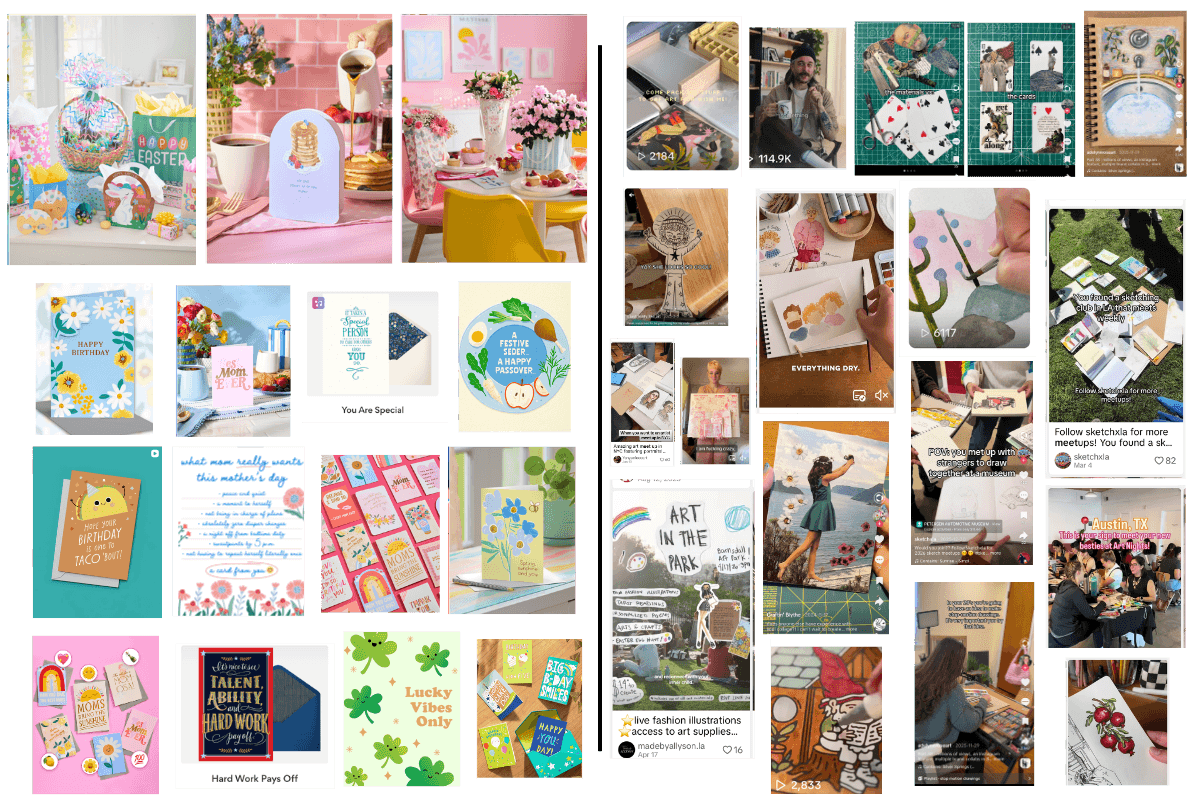
Just look at the vibe shift — sterile and staged on the left, real and community-focused and creative on the right. And this is just what comes from 15 minutes searching TikTok, screenshotting and pulling into Canva. S/O to the artist accounts I included: @madebygracelynn, @sketchxla, @artnights_atx, @adelynnroseart, @craftinblythe, @madebyallyson.la, @boringfriendsdesign, @duck.rai and @i_just_really_like_art.
To be clear, Stamp'd isn't the only product play here. A physical subscription box, a curated independent-card retail partnership, a vet office distro program for next-level patient sympathy and support — any of these would fit the same IRL pendulum swing. Stamp'd just happens to be the one I'd build first because it generates the most earned media ROI.
Step 4: AI visibility monitoring
The last step of the Loop is measurement — tracking whether the work is actually changing AG's AI citation footprint.
Baseline that I'd set week one: the 65/100 brand consistency score, the 56% share of voice on discovery queries (dragged down by the use-case queries where AG is barely cited), the 19 of 42 grounding searches where they rank in the top 30, and the seven missing features across every AI tool.
Then you watch those numbers move as Stamp'd builds earned media, as retail collateral updates AG's positioning language, as the creator network generates third-party mentions, and as the sub-brand starts ranking for place-specific greeting card queries ("Nashville themed birthday party" for the 40th celebrated in music city, "Michigan summer thank you card" to send after the weekend as a guest at your friend's lakehouse, and "locally made gift ideas" for the person who refuses to support Jeff Bezos).
I'd expect significant improvement on the brand identity language within 90 days max of the first tour stop. AI datasets update fast, and a tour like this could generate content that literally creates itself (the artists and consumers will be so impressed THEY will create the content for AG), across every source (since, remember each AI platform prioritizes different sources when citing). I'd expect the share-of-voice gap on use-case queries to close within 6-9 months once larger third-party PR sources would get a whiff of the campaign and highlight it.
What legacy brands can learn from American Greetings' analog moment
American Greetings doesn't have bad marketing — they have typical marketing. But their brand isn't in a typical situation with this societal shift.
The AI visibility data makes the shift visible in a way SEO ranking reports and social metrics could never show. When the biggest name in greeting cards is being treated as generic category context by the systems that will mediate more and more buying decisions every year, that's not a problem the content calendar can fix. It requires strategic repositioning.
Implementing this strategy isn't easy peasy. It's not an A/B or new lead magnet offer. It's picking a side of the barbell and committing, building a sub-brand that lets you be on both sides, and using the earned media from the physical side to update the AI dataset that's currently describing you with language from a decade ago.
Every 100-year-old brand is going to face this moment in the next five years. The ones that win will be the ones that stop trying to be everything and start being undeniably ONE thing — who they were when they started.
I'm Laura Seelinger, founder of LSX Partners. This is the kind of strategy I build and help clients implement. If you're running marketing at a company stuck between its legacy and its next chapter, and you want someone who knows how to truly tap into what the target audience wants, we should chat.
Sources
Gen Z and millennial digital fatigue data:
The Harris Poll, The Return of Touch Report: Reimagining Consumer Engagement in 2025, presented by Quad. Nationally representative survey of 2,068 US adults (125 Gen Z, 492 millennials, 571 Gen X, 806 boomers, 74 silent/greatest generation), conducted January 16 to February 5, 2025.
Fortune, "Subscriptions burned out Gen Z. They're going for analog lifestyles and physical media instead," March 2026. Cites Civic Science data on Gen Z subscription cancellations.
American Greetings AI visibility data:
AI Visibility Report generated via Spyglasses, April 2026.
American Greetings SEO data:
SEMrush Domain Overview and Organic Rankings, americangreetings.com, April 2026.
Greeting card industry trends:
Greeting Card Association industry data on millennial purchasing behavior and category trends.